 In a sleepless night, i tried to finish the last few chapters of a book that i had left behind for a while -- a memoire of Jimmy White. For all times, White is a legend in the snooker world, but a tragedy figure, i hate to say it. Imagine you compete all the way up to the final round of the World Championship tournament and lose it. White did it, not once, but for six times. In 1994, he got the closest chance there against Stephen Hendry. He led the final frame and all he needed to do was just a few pots, but he missed an easy chance.
White, dubbed the Whirlwind, dropped out school in an early age and dashed around under snooker tables in a ruin English town. Born to the times when vodka was part of the game, he got drunk before matches started. He dared do trick shots in serious matches, enjoyed the matches and made sure that the audience knew that. Together with Steve Davis and Hendry, White brought the English game to a worldwide event. He had its part to lure a generation of Hong Kong teenagers into snooker clubs. He acted in a 周星馳 comedy, playing Jimmy White, himself, whom the comedian finally defeated. The Whirlwind gave us so much wonder, but he owed himself just a few shots -- he badly deserved.
"Life - like snooker - is not like, "I'm sorry I'll read that again", and it never be when you miss a shot.... No, the last shot you played is consigned to history.... The past belongs to the pundits and the statistics boys. There is only 'tomorrow' to deal with, which is as it should be. Look to the next shot. It might rain tomorrow, and it might not. But that's why people who live by duckin' an' divin' always say, 'Be lucky.'" Jimmy tells the story of an easy guy who bears the bitterness of life.
Ronnie O'Sullivan is the finest naturally gifted snooker player of his time. His performance is simply sensational. The English genius strikes with either hand, plays by instinct, and with stunning speed, which earned him the nickname "Rocket". A perfect 147 break is the dream of every snooker player. Hong Kong's Marco Fu made it once in his career. The Rocket did it six times. While looking good, he also did it the fastest. In April, the 2004 World Champion was defending his title, but surprisingly failed.
In the quarterfinal, Rocket's rival was the subtle Peter Ebdon who was ranked number 10 in the sport. It seemed nothing could stop the Rocket when he finished the morning session leading Ebdon 10-6. Afterwards, Ebdon changed the tactics and hence the whole game. He started to play slowly, very slowly. Snooker is boring, perhaps to many readers, but of course not to the professionals.
This time, even the Rocket couldn't stand the boredom when Ebdon took three minutes over a shot. O'Sullivan made a joke with a spectator, asking what the time was. Ebdon then spent another five minutes for the next few pots. His pauses irritated the short-tempered Rocket and destroyed his jazzy rhythm. Ebdon eventually won 13-11. The slower is the better.
Nowadays, everything is rushed for deadlines. We like fast food, instant noodles, Ferrari, non-stop flights, etc. Our brains tend to allocate different time allowance between trivial tasks from important jobs. They mandate us to do the trivial things at the fastest speed, saving time for the important jobs. That's clever. The trivial tasks include banking, tax filing, custom clearance, etc. Automation helps us do these tasks quickly.
But our brains are not perfect. They seem to have a problem identifying which tasks are important and which are not. We have wrongly identified eating as one of the trivial tasks they should finish as soon as possible. We had long liked fast food until recently when we realized fast food is unhealthy.
A businessman who treats his company as a tool to make easy money might miss the point. Jim Collins and Jerry Porras, in their classic "Built To Last", argue that great companies got their starts on low gears. They reject the myth that great companies started with brilliant ideas. "The long race goes to the tortoise, not the hare." Initially, Hewlett Packard made a bowling foul-line indicator, a clock drive for telescopes, a thing to make a urinal flush automatically and a machine to help people lose weight. Sony's first product was a rice cooker, which failed to work properly.
Great ideas shift his attention away from seeing the company as his ultimate creation, the authors point out. He is more likely to give up on the company if the idea fails. If that idea succeeds, he tends to have an emotional love affair with that idea and stick with it too long, when the company should, instead, move on.
Wal-Mart started slowly but later beat Ames Stores, which pioneered the rural discount retailing.
On investment, the tortoise beats the hare.
Many investors dream to become millionaires overnight. Some of them can make it, by their luck or competence, or both. Few people would walk out of the casino after hitting a jackpot. They will then bet even more aggressively in the hope to win even more. More likely than not, they would eventually lose their fortunes.
Great investors such as Warren Buffett and sifu Tony Measor are masters of the long-term investment. They buy a stock and let it grow. They do not trade frequently. After paying dividends, a good company retains profits and reinvests them efficiently to generate even more profits. The growth takes time and is influenced by market cycles. Therefore, investors need to have patience. But the patience will be well rewarded.
That's how a good player can win over a genius.
"When I'm trying my hardest I seem to go slow. I don't do it intentionally," said Ebdon after the game. The Rocket said he was considering taking a year break from the sport. The 29-year-old had, for several times in the past, said to retire. He will be missed if he takes the break. When he comes back, on which i have no doubt, he will become even stronger than before.
Jun 1, 2005
Copyright Quamnet
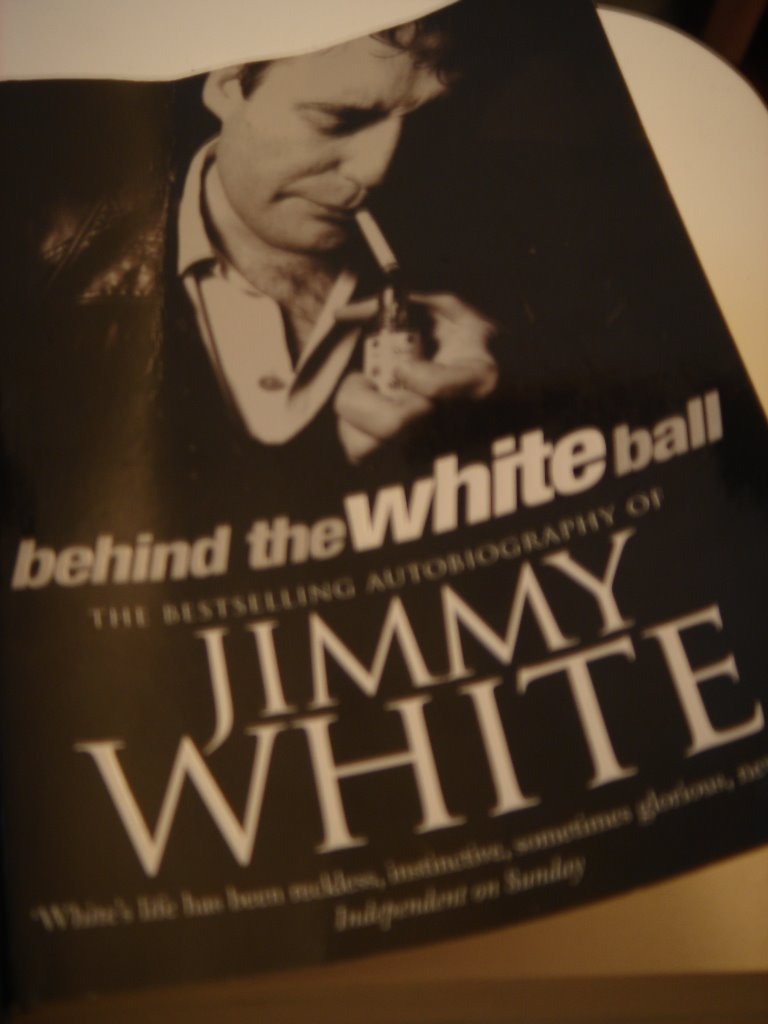 In a sleepless night, i tried to finish the last few chapters of a book that i had left behind for a while -- a memoire of Jimmy White. For all times, White is a legend in the snooker world, but a tragedy figure, i hate to say it. Imagine you compete all the way up to the final round of the World Championship tournament and lose it. White did it, not once, but for six times. In 1994, he got the closest chance there against Stephen Hendry. He led the final frame and all he needed to do was just a few pots, but he missed an easy chance.
